Friday, 31 January 2014

Interview Sequence Deconstruction

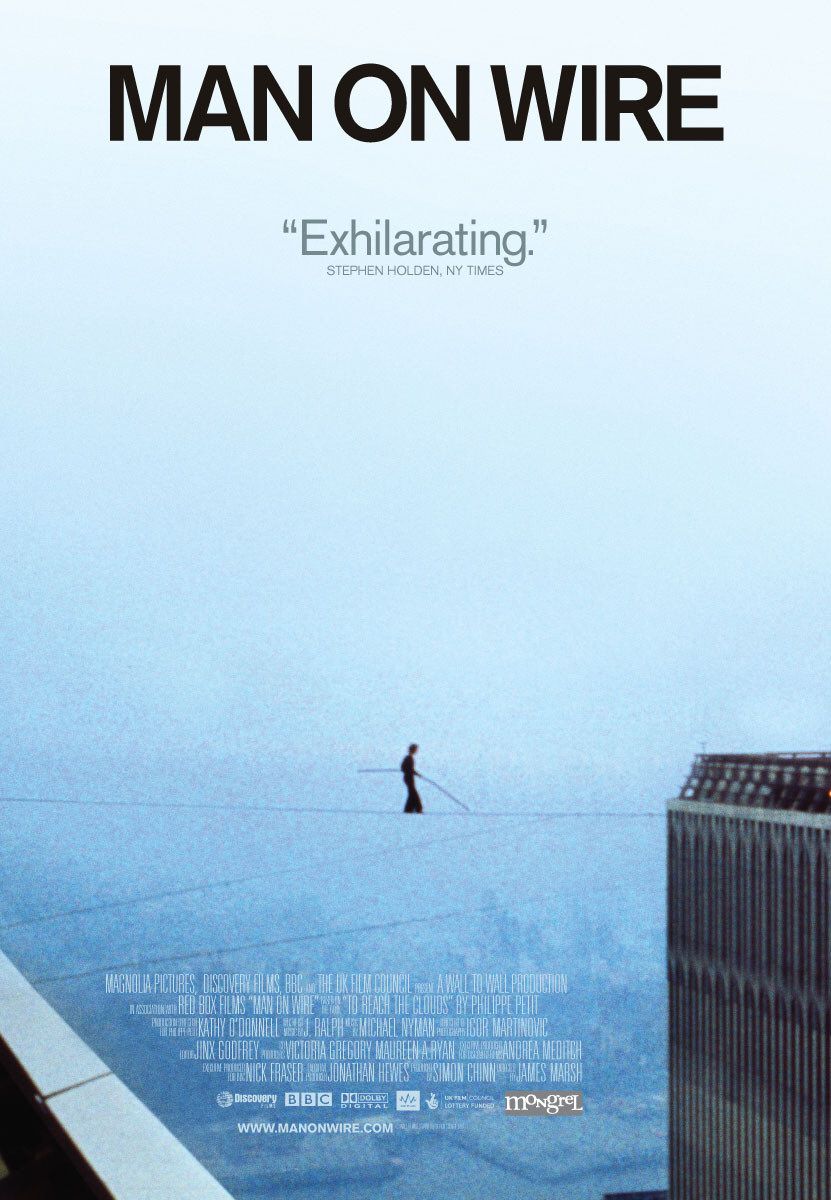
For my interview sequense deconstruction, I have chosen a scene from the documentary "Man on a wire" from 2008. It depicts the Frenchman Philippe Petit in his successful attempt to walk on a wire set up between the Twin Towers of the World Trade Center, New York City in 1974. In the 25 minutes he spend on the wire he was walking, dancing, kneeling and lying on the wire, while a flock of horrified people watched him from the street level.

The documentary tells a story about friendship, doubt and taking a chance. With Philippe Petit as the main character, we get a look into the childhood and youth of his life and friends, and how he came to walk a line between the World Trade Centre. The documentary is filled with archive footage, pictures and interview sequences, all nicely stitched together.

The sequence I have chosen depicts the day of the wire walking, just before Philippe steps on to the wire. The sequence start at around 1:14:50 into the documentary and end at 1:19:10.
The interview scene with the male characters are filmed in a hard light. This intensify the situation just before Philippe steps on to the wire. The mood in the documentary completly changes, as a light and easy piano piece is playing in the background, while pictures of Philippe walking on the wire are displayed. Calmness takes over the viewer. Philippe describes the process of his wire walking in a mix of voice-overs and interview scenes. 

As the interview continues, the characters show emotion and determination. They way they are framed in a close shot enables the characters to show both emotions and gesticulation. The framing creates intimate framing to show the emotional state of the characters, and allows the viewer to become more familiar with them.

The hard shadow interview sequences are shot in colour, to distance them from the flash-back sequences. The viewer doesn't doubt what is real-time and what is flash-back. The photographs of Philippe are framed with a balance in the shot to illustrate that he is confident and balanced, while the pictures of the crowds looking at Philippe at the street level are framed in a dutch angle to illustrate their worried state of mind. The dutch angle effect gives the impression that the crowd is about to fall, and not Philippe.  


Friday, 17 January 2014

Photo Portfolio

As 60% of our Practise Portfolio, we had to do a photo portfolio. This portfolio needed to consist of 20 pictures and had to demonstrate the understanding of the following themes:


·       Composition

·       Lens Choices

·       Control of Aperture

·       Control of digital ‘film speed’ or ISO

·       Control of Shutter

·       Use of Focus (& it’s relationship with light).


Each photo had to be constructed with a demonstration of the specific theme, and contain no more than 20 pictures in total. This meant we had to construct pictures with one or more of the following concepts:


Balance / Imbalance in frame, Clear Directionality in line, Linear Perspective (Converging Diagonal Lines), Open Frame / Closed Frame, Frame within a Frame, The Rule of thirds, The ‘Sinuous S’, Compositional Triangle, Effect of Short Lenses on space, Effect of Long Lenses on space, Deep Focus, Shallow or Specific Focus, Under Exposure, Correct Exposure, Over Exposure, Blurred movement within a still frame, Sharp movement within a still frame & Night Scene.

The portfolio also had to have a specific theme, to where I chose the theme "Human Interaction". My plan through the portfolio was to create a scenario that could have been taken straight out of a film, but reached the conclusion that shooting the pictures would be easier if I didn't have to construct a specific scenario around each picture.

I decided to shoot the pictures on a day where fog covered the ground. I took a couple of friends to the local park in my area, and placed them accordingly to my plan. Since I had to demonstrate the different concepts, I decided to go location hunting in the park. As I found the specific places where I wanted to shoot the pictures, I shot a couple of different scenarios before deciding on the final image.

Since the pictures had to be shot with a dSLR camera, I was lucky my roommate owned a Canon EOS 5D Mark II with a 17-40mm f/4L, a 85mm f/1.8 and a 100mm 2.8L. I shot my entire portfolio on these three lenses, and it definitively made the practice easier. When working on a full frame camera, you have the opportunity to shoot cleaner images, and it is easier to crop into the images if needed, without loosing to much information.

I was lucky to shoot my entire portfolio on a beautifull day, where fog covered the entire park. The pictures came out with an almost angelic light, and a feeling that is hard to reproduce.

As I finished the portfolio, I noticed how much more aware I had become with the different concepts, and I felt like learning a lot. The experience is definitively one I can take with me in my future work as a photographer and cinematographer!

Some of the images can be seen here:

Monday, 6 January 2014

Semester in Review

Coming from communication and IT, it is something else to be thrown into a completely different style of studying. 

First of all, I like how this is more hands on that I have ever been in my entire life. Learning by doing makes me learn the techniques better. It is always fun to explore the theories after you study their background and use. I like being able to prove my worth in a studio, and I definitively got to do that in the first semester. I was both a Camera operator, and a VT operator several times. I can't say that VT was the most enjoyable thing, but it was definitively an experience. Being tucked away in a little dark and noisy room wasn't my idea of a good TV production, but you learn something every day, and in the end without the vt being on the spot, the whole production would be a mess.

The tutorials I went through, made me more aware of the roles and the high level of respect you have to have towards the equipment you are using. With both Pete and Barry being my tutors, I slowly but steady build up a knowledge for the practice.

A big percentage of the coursework on the coursework on the first semester included a photo portfolio. I found this to be an exciting opportunity to show of my technical skills and combine them with what I had learned from the coursework. The university loan-store had a wide selections of cameras, but what I don't understand is why we were only able to borrow the Canon EOS 7D's and below. The 7D kit gave us as students a chance to explore the differences in lenses, even though the kit lenses were rather basic pieces of glass. 

The Middlesex Now shows were quite fun to make, and quite interesting to be a part of. I had never been a part of a TV production before, so being thrown into the role of being cameraman was scary. I decided to do my best, and ended up failing a bit. But that only made me learn about what I shouldn't do the next time I operated a camera.

Both the deconstruction and the research proposals sounded like quite interesting assignments to do. It gave me an opportunity to explore film more in-debt, but also research the techniques used to produce film and TV. It is hard to choose two films to compare, since there are so many good choices, but I decided to go along with something that appealed to my mind. Also the research assignment have given me an opportunity to search into a very specific interest I have in terms of post-production.